PRK (Photorefractive Keratectomy)

PRK, or photorefractive keratectomy, is a type of laser eye surgery that helps you see more clearly without relying as much on glasses or contacts. At West Texas Eye Associates, our refractive surgery team evaluates your eyes, prescription, corneal health, and vision goals to determine whether PRK or another vision correction procedure is best suited to you.

What Is PRK Eye Surgery?

PRK, or Photorefractive Keratectomy, is a type of laser eye surgery aimed at enhancing how light focuses in your eye. For clear vision, light must travel through the cornea, but if its shape causes the light to be incorrectly focused, you might struggle with blurry vision due to nearsightedness, farsightedness, or astigmatism.

During the PRK procedure, your surgeon starts by removing the thin outer layer of cells on the cornea known as the epithelium. Following this, a laser is used to carefully reshape the underlying corneal tissue in accordance with your personalized vision correction plan. To aid in the healing process, a protective bandage contact lens is placed over the eye, allowing the epithelium to grow back naturally.

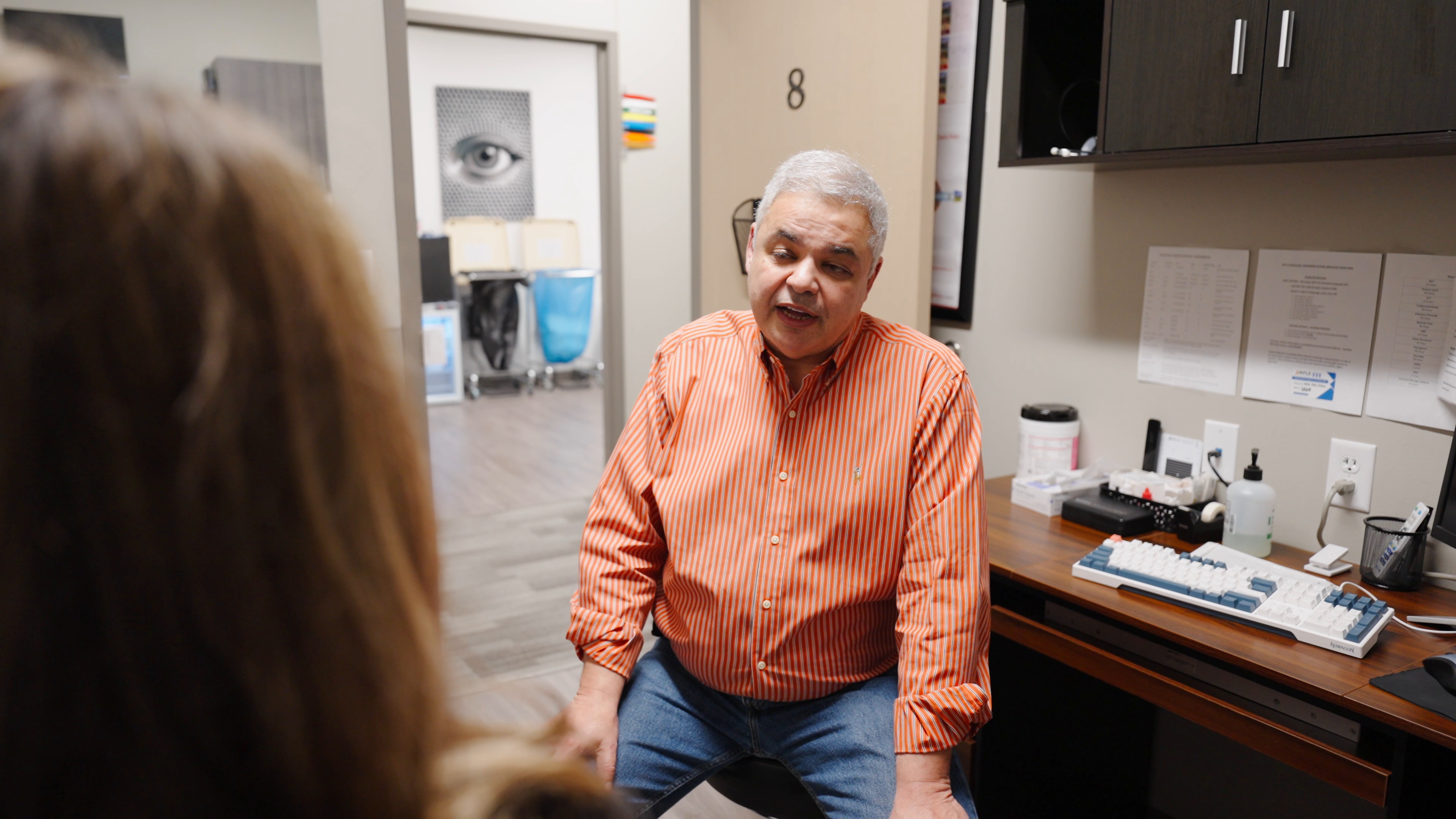
Play Video
Video thumbnail

What Does PRK Correct?

PRK can be used to correct several common refractive errors

If you are nearsighted, nearby objects may look clear while objects farther away appear blurry. PRK reshapes the cornea so light can focus more accurately on the retina.

Farsightedness can make close-up vision more difficult and, depending on your prescription, may also affect distance vision. PRK may be used to reshape the cornea and improve vision.

Astigmatism occurs when the cornea or lens has an irregular curvature, causing distorted or blurred vision. Laser vision correction can reshape the cornea to create a more regular focusing surface.

PRK vs. LASIK: What’s the Difference?

PRK and LASIK are both laser vision correction procedures that reshape the cornea to improve how your eye focuses light. The biggest difference is how your surgeon accesses the cornea during treatment.

PRK LASIK
How it works The thin outer layer of the cornea is gently removed before the laser reshapes the cornea. A thin corneal flap is created and lifted before the laser reshapes the tissue underneath.
Corneal flap No flap is created. A thin flap is created and repositioned after treatment.
Recovery Initial recovery is slower because the cornea naturally heals. Initial visual recovery is typically faster.
Corneal thickness May be an option for some patients with thinner corneas who are not ideal LASIK candidates. Requires enough corneal tissue to safely create the flap and perform treatment.
Lifestyle considerations A flap-free approach may be preferred for certain active lifestyles, occupations, or activities. May be appropriate for many patients who want quicker initial recovery.
Best for Patients whose eye anatomy or lifestyle may make PRK a better option. Patients whose prescriptions, corneal anatomy, and eye health make them good candidates for LASIK.

Which Is Better: PRK or LASIK?

Neither PRK nor LASIK is automatically better. The best procedure depends on your prescription, corneal thickness, eye health, lifestyle, and vision goals. At West Texas Eye Associates, your refractive surgeon will evaluate your eyes and recommend the vision correction option that makes the most sense for you.

Who Is a Good Candidate for PRK?

You may be considered for PRK if you:

  • Are you an adult with a stable prescription for glasses or contact lenses?
  • Have nearsightedness, farsightedness, or astigmatism within a treatable range.
  • Have healthy eyes and corneas.
  • Want to reduce your dependence on glasses or contacts.
  • Have corneas that may not be ideal for LASIK.
  • Prefer or require a laser vision correction procedure that does not create a corneal flap.

Certain eye conditions, medical conditions, medications, pregnancy, unstable prescriptions, or corneal abnormalities may affect whether PRK is appropriate.

Schedule a FREE PRK Consultation

Close-up of an eye illuminated during a PRK eye surgery evaluation.

PRK Recovery

Smiling woman enjoying clear vision outdoors after PRK eye surgery recovery.

PRK recovery is more gradual than LASIK, but studies show strong visual outcomes as the eyes heal.

During the first few days, you may experience blurry vision, light sensitivity, tearing, irritation, or mild discomfort, while a protective bandage contact lens helps the eye heal. Vision typically begins improving as the surface recovers, but it may continue to fluctuate for several weeks.

In a published study of 222 eyes treated with modern PRK, 86.5% achieved 20/20 or better uncorrected vision by three months, and 97.7% were within 0.50 diopters of their intended correction; researchers also found that refractive results were stable by the three-month mark. More recent research found similar results: a 2025 study reported that 82% of PRK-treated eyes achieved 20/20 or better vision at three months and 98% were within 0.50 diopters of their target correction. Individual recovery and results vary based on your prescription, eye health, and how your eyes heal.

Find Out if PRK Is Right for You

Not sure whether PRK, LASIK, or another vision correction option is right for your eyes? Start with a FREE vision correction consultation at West Texas Eye Associates. Our team will evaluate your prescription, corneal health, and vision goals, answer your questions, and help determine which procedure may be the best fit for you.

FAQ: PRK at West Texas Eye Associates

PRK, or photorefractive keratectomy, is a laser vision correction procedure that reshapes the cornea to improve nearsightedness, farsightedness, and astigmatism. Unlike LASIK, PRK does not require the creation of a corneal flap.

Neither PRK nor LASIK is better for everyone. LASIK generally offers a faster initial visual recovery, while PRK uses a flap-free approach that may be better suited for certain corneas, prescriptions, lifestyles, or occupations. Your surgeon can determine which procedure is appropriate for your eyes.

Possibly. Some patients who are not ideal LASIK candidates may still qualify for PRK, particularly when corneal thickness or other anatomical factors make creating a LASIK flap less desirable. A comprehensive vision correction evaluation is necessary to determine your options.

Vision improvement after PRK is gradual. The surface of the cornea typically heals during the first several days, but vision can continue to sharpen and stabilize over the following weeks and months. Every patient heals differently, so your surgeon will monitor your progress during follow-up visits.

Numbing eye drops are used during PRK to help keep you comfortable throughout the procedure. After treatment, patients may experience irritation, tearing, light sensitivity, or discomfort for several days as the corneal surface heals.

PRK can treat eligible patients with astigmatism as well as nearsightedness and farsightedness. Your prescription and corneal measurements will help determine whether PRK can safely provide the amount of correction you need.

Many patients achieve 20/20 vision after PRK, but no laser vision correction procedure can guarantee 20/20 vision. Your expected results depend on factors including your prescription, corneal health, age, and individual healing response.

Most of our patients reduce their dependence on glasses or contact lenses with PRK, but some patients may still need glasses for certain activities. Your eyes can also continue to change with age, including the development of presbyopia and other age-related vision changes.

Good PRK candidates are generally adults with a stable prescription, healthy eyes, and a refractive error that can be safely treated with laser vision correction. Corneal shape, thickness, overall eye health, medical history, and your vision goals are also considered before surgery.

Start with a FREE vision correction consultation at West Texas Eye Associates. Our team can evaluate your prescription, corneal health, and vision goals to help determine whether PRK, LASIK, EVO ICL, or another vision correction option is the best fit for your eyes.

Locations

3611 50th St
Lubbock, TX 79413

Clinic

4804 S Loop 289
Lubbock, TX 79414

Surgery Center

12210 Quaker Ave
Lubbock, TX 79424

Clinic

Doctors

Jay C. Bradley, MD
Jay C. Bradley, MD

Fellowship-trained Ophthalmologist, Refractive Surgeon, Cornea Specialist

Timothy T. Khater, MD, PhD

Fellowship-trained Ophthalmologist, Cornea Specialist & Cataract & Refractive Surgeon