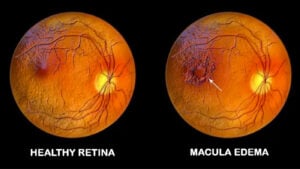
Cystoid Macular Edema: Blurry Central Vision After Cataract Surgery
Cystoid macular edema is swelling in the macula that can cause blurry central vision after cataract surgery. If you notice haze, distortion, or a gray spot in your straight-ahead vision, the retina specialists at West Texas Eye Associates can confirm the cause and start treatment quickly.
What Is Cystoid Macular Edema
Cystoid macular edema, often called CME, occurs when fluid gathers in tiny pockets within the macula. The macula is the part of the retina responsible for reading, recognizing faces, and color detail. After cataract surgery, postoperative inflammation can increase fluid leakage from retinal blood vessels, creating cyst-like spaces that blur fine detail. Untreated CME may persist, but most cases improve with timely care.
Why It Happens After Cataract Surgery
Most cataract surgeries heal smoothly. A smaller group of patients develops more inflammation that leads to CME. Risk is higher with diabetes, uveitis, retinal vein occlusion, epiretinal membrane, complicated surgery, or a history of CME in the other eye. CME reflects postoperative inflammation, not a surgical failure, and it is usually reversible with treatment.
Symptoms You Might Notice
Blurry or milky central vision
Straight lines or print look wavy
Colors appear washed out
A central gray spot that makes reading difficult
How We Confirm The Diagnosis
Optical coherence tomography to visualize swelling and measure improvement over time
Fluorescein angiography is used when needed to map leakage and exclude other causes
Refraction and visual acuity to track changes as treatment progresses
Injections when needed, such as periocular or intravitreal corticosteroids, and anti-VEGF in selected cases or when diabetic retinopathy coexists
Address contributors by managing blood sugar and evaluating epiretinal membrane or vein occlusion
Close follow-up using imaging to guide drop tapering and confirm resolution
What Recovery Looks Like
Many patients notice sharper central vision within weeks. Others improve over a few months with a gradual taper of medications. Your care team will show you OCT images as the fluid clears and will coordinate with your cataract surgeon.
How To Lower Future Risk
Maintain good control of diabetes and blood pressure
Use all prescribed pre- and post-operative drops as directed
Keep follow-up visits so small changes are caught early
When To Call Us
If you notice a new central blur, wavy lines, or a gray spot after cataract surgery, contact West Texas Eye Associates for a same-week evaluation. Early treatment protects the macula and daily independence.
FAQ
How common is cystoid macular edema after cataract surgery?
It is one of the more frequent causes of suboptimal vision after surgery, but most cases are mild and respond to drops.
Will cystoid macular edema go away on its own?
Some cases improve without intervention, but treatment usually speeds recovery and protects the macula.
Can cystoid macular edema come back?
Yes, especially if risk factors are present. We create a prevention plan for future procedures.
Does cystoid macular edema mean my surgery failed?
Clear central vision is achievable after cataract surgery, even if cystoid macular edema appears. If you are noticing blur or distortion, schedule a retina evaluation with West Texas Eye Associates. Our specialists will confirm the diagnosis and start a treatment plan that restores clarity.
Related Posts
Protect Your Vision: Schedule an Eye Exam
Regular eye exams can help detect changes in your vision and signs of eye disease before they begin affecting your everyday life. Schedule your appointment online or call (806) 792-5900 to take the next step in preserving your sight and maintaining healthy vision.
To provide the best experiences, we use technologies like cookies to store and/or access device information. Consenting to these technologies will allow us to process data such as browsing behavior or unique IDs on this site. Not consenting or withdrawing consent, may adversely affect certain features and functions.
Functional
Always active
The technical storage or access is strictly necessary for the legitimate purpose of enabling the use of a specific service explicitly requested by the subscriber or user, or for the sole purpose of carrying out the transmission of a communication over an electronic communications network.
Preferences
The technical storage or access is necessary for the legitimate purpose of storing preferences that are not requested by the subscriber or user.
Statistics
The technical storage or access that is used exclusively for statistical purposes.The technical storage or access that is used exclusively for anonymous statistical purposes. Without a subpoena, voluntary compliance on the part of your Internet Service Provider, or additional records from a third party, information stored or retrieved for this purpose alone cannot usually be used to identify you.
Marketing
The technical storage or access is required to create user profiles to send advertising, or to track the user on a website or across several websites for similar marketing purposes.