Vitreomacular Traction: Causes, Symptoms, and Treatment
How Is Vitreomacular Traction Treated?
The best treatment for vitreomacular traction depends on how strongly the vitreous is pulling on the macula and how much that traction is affecting your vision. The overall goals are straightforward: to relieve traction, protect the macula, and preserve your central vision. Dr. Douglas Jin will review your images, explain your options, and recommend the safest course of action for your eyes.
Observation and Careful Monitoring
Not every case of vitreomacular traction needs immediate treatment. If the traction is mild and your vision remains strong, your doctor may initially recommend close observation.
Use an Amsler grid at home to watch for new distortions, wavy lines, or blank spots
Call the clinic right away if you notice a sudden change in vision, an increase in floaters, or new flashes of light
In some patients, the vitreous finishes separating from the retina on its own. When that happens, the pulling force eases, and symptoms can improve without any procedure.
Medication Injection (Ocriplasmin)
For some patients, ocriplasmin can help release the vitreous from the macula without the need for surgery. The medication works by gently breaking down the microscopic fibers that hold the vitreous in place.
What to expect:
The medicine is injected into the eye in a sterile clinic setting
The injection itself only takes a few seconds
You may notice temporary floaters or blurred vision while the medicine does its work
If the treatment is successful, the vitreous separates, the traction decreases, and the macula has a chance to recover
Dr. Jin will decide whether you are a good candidate based on your OCT scans, tractional pattern, and overall eye health.
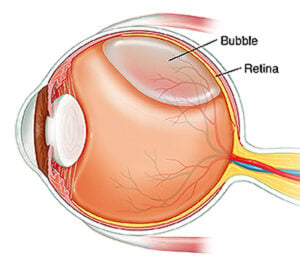
Pneumatic Vitreolysis
uses a small gas bubble to help separate the vitreous from the macula.
During this procedure:
Your doctor injects a tiny gas bubble into the vitreous cavity
The bubble rises inside the eye, so you follow specific head positioning instructions, often looking downward or toward one side for short periods throughout the day.
As the bubble presses on the vitreous, it can encourage the remaining attachment to release.
Sometimes pneumatic vitreolysis is combined with medication to improve the chance of success. This option is not right for everyone, especially if there is significant scar tissue, advanced retinal disease, or if you cannot safely maintain the required head positions. Your doctor will review these details with you before recommending this approach.
Vitrectomy Surgery
When vitreomacular traction causes significant vision loss, threatens a macular hole, or fails to respond to less invasive options, vitrectomy surgery may be the most reliable way to relieve the traction.
The surgeon creates tiny openings in the white part of the eye
The vitreous gel is carefully removed and replaced with a clear solution
Any traction or scar tissue on the macula is gently peeled away
Additional steps, such as laser treatment or a temporary gas bubble, may be used if there is a risk of retinal detachment or a macular hole.
Vitrectomy is typically performed as an outpatient procedure in a surgery center. Recovery time varies from person to person. Many patients notice gradual improvement in distortion and clarity over several weeks, with ongoing healing over a few months. Your postoperative instructions, including any activity limitations and positioning requirements, will depend on the specifics of your surgery.
Living With Vitreomacular Traction
If you have been diagnosed with vitreomacular traction, consistent follow-up is just as necessary as the treatment itself. Between appointments, you can support your eye health by:
Using an Amsler grid once or twice a week to check each eye separately
Keeping blood sugar and blood pressure well controlled, especially if you have diabetes or hypertension
Contact your retina clinic promptly if you notice new floaters, flashes of light, a curtain or shadow in your vision, or a sudden change in your vision clarity.
Your retina specialist, Dr. Jin at West Texas Eye Associates, will tailor your monitoring schedule and treatment plan to the specific findings in each eye, so you always know what to watch for and when to return.
Commonly Asked Questions About Vitreomacular Traction
1. Is vitreomacular traction the same as a macular hole?
No. Vitreomacular traction refers to the pulling force exerted by the vitreous on the macula. A macular hole is an actual opening in the central retina that can form if the pulling force becomes strong enough. Treating traction at the right time can sometimes prevent a macular hole from developing.
2. Will glasses or contact lenses fix vision changes from vitreomacular traction?
Glasses and contacts correct refractive errors, for example, nearsightedness or farsightedness. They cannot correct the distortion or blurring caused by traction on the macula. That is why evaluation and follow-up with a retina specialist are so critical.
3. How long does recovery take after vitrectomy surgery for vitreomacular traction?
Recovery timelines vary. Many patients notice a reduction in distortion and an improvement in clarity over several weeks, with further enhancement continuing for the next few months. Your doctor will explain how long to avoid heavy lifting, how long any gas bubble may remain in the eye, and when it is safe to return to work, driving, or exercise.
4. Can vitreomacular traction affect both eyes?
Yes. Age-related changes in the vitreous can occur in both eyes, so some patients develop traction in one eye first, then in the other. Regular exams help detect changes early, allowing treatment to be administered at the most appropriate time.
5. If my symptoms are mild, can I wait and see?
Sometimes, yes; however, that decision should be made together with a retina specialist. Mild traction may release on its own, but you still need a clear follow-up plan, regular OCT scans, and specific instructions about when to call if symptoms change.
Protect Your Macular Vision Today
Vitreomacular traction can sound intimidating; however, knowledge and early care put you in control. With modern imaging, experienced retina specialists, and multiple treatment options, many people maintain strong, functional central vision for years after diagnosis.
If you are noticing wavy lines, new central blurring, difficulty reading, or if another doctor has mentioned vitreomacular traction, the next step is a comprehensive retinal evaluation.
Contact West Texas Eye Associates today to schedule an appointment. Our retina team will explain your scans in plain language, answer your questions, and help you choose the safest and most effective plan to protect your macular vision and your day-to-day independence.
Related Posts
Protect Your Vision: Schedule an Eye Exam
Regular eye exams can help detect changes in your vision and signs of eye disease before they begin affecting your everyday life. Schedule your appointment online or call (806) 792-5900 to take the next step in preserving your sight and maintaining healthy vision.
To provide the best experiences, we use technologies like cookies to store and/or access device information. Consenting to these technologies will allow us to process data such as browsing behavior or unique IDs on this site. Not consenting or withdrawing consent, may adversely affect certain features and functions.
Functional
Always active
The technical storage or access is strictly necessary for the legitimate purpose of enabling the use of a specific service explicitly requested by the subscriber or user, or for the sole purpose of carrying out the transmission of a communication over an electronic communications network.
Preferences
The technical storage or access is necessary for the legitimate purpose of storing preferences that are not requested by the subscriber or user.
Statistics
The technical storage or access that is used exclusively for statistical purposes.The technical storage or access that is used exclusively for anonymous statistical purposes. Without a subpoena, voluntary compliance on the part of your Internet Service Provider, or additional records from a third party, information stored or retrieved for this purpose alone cannot usually be used to identify you.
Marketing
The technical storage or access is required to create user profiles to send advertising, or to track the user on a website or across several websites for similar marketing purposes.