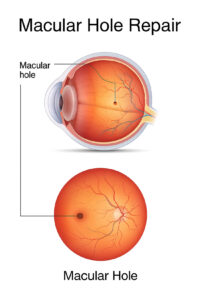
If you’ve noticed a dark spot in central vision, you may be dealing with a macular hole, a small break in the retina’s center that blurs or distorts what you see straight ahead. It can be alarming when your sight changes suddenly, but early diagnosis and expert care make a difference.
At West Texas Eye Associates, retina specialist Dr. Douglas Jin helps patients throughout Lubbock and West Texas understand their symptoms and regain clear, comfortable vision.
What Is a Macular Hole?
The macula is the center of the retina, the light-sensitive tissue at the back of your eye that captures fine detail and color. A macular hole occurs when this tissue becomes stretched or torn, creating a small opening that distorts central vision.
Macular holes develop most often as part of the normal aging process. The gel-like substance inside the eye (called the vitreous) naturally pulls away from the retina as we age. This pulling sometimes causes enough tension to create a hole in the macula.
Symptoms of a Macular Hole
A macular hole can start small and worsen over time, so early diagnosis is key. Common signs include:
A dark, gray, or blurry spot in the center of your vision
Straight lines appearing wavy or distorted
Difficulty reading or recognizing faces
Central vision loss in one eye (while peripheral vision remains normal)
If you notice any of these symptoms, it’s essential to schedule an eye exam promptly. Early evaluation allows for more effective treatment and better visual outcomes.
What Causes a Macular Hole?
Macular holes most often occur as a natural part of the aging process. As we get older, the vitreous gel that fills the eye can shrink and pull away from the retina. In some cases, it tugs too firmly, creating a small tear or hole in the macula.
While age-related changes are the leading cause, other factors can increase your risk:
Eye injury or trauma
High myopia (severe nearsightedness)
Retinal detachment or prior retinal surgery
Diabetic eye disease or macular swelling
How Is a Macular Hole Diagnosed?
At West Texas Eye Associates, diagnosis begins with a comprehensive retinal exam using advanced imaging technology such as optical coherence tomography (OCT). This painless scan provides a cross-sectional view of the retina, allowing Dr. Jin to visualize the hole, measure its size, and plan the most effective treatment.
Treatment for Macular Holes
The most common and effective treatment for macular holes is a vitrectomy, a delicate microsurgery that removes the vitreous gel, pulling on the retina. During this procedure:
The vitreous gel is gently removed.
The hole is treated to relieve traction.
A small gas bubble is placed inside the eye to help the hole seal and heal.
Patients typically notice gradual improvement in vision over weeks to months as the eye recovers. Some smaller macular holes may close on their own or be monitored closely with regular exams.
Recovery and Outlook
After surgery, the gas bubble acts like a gentle “bandage,” supporting healing. Patients may need to keep their head in a specific position for a few days to keep the bubble in place.
With timely treatment, many patients experience partial to significant restoration of vision. However, untreated macular holes can lead to permanent central vision loss.
When to See a Retina Specialist
If you notice a dark spot in your central vision, don’t ignore it — especially if it worsens or distorts your sight.
At West Texas Eye Associates, Dr. Douglas Jin and our retina care team provide comprehensive evaluation and treatment options, from advanced imaging to microsurgical repair, right here in West Texas.
Schedule a Retinal Evaluation
Your sight is too important to wait. If you see dark or blurry areas in your central vision, schedule an appointment with Dr. Douglas Jin at West Texas Eye Associates. Early diagnosis and treatment of a macular hole can make all the difference in preserving your vision and quality of life.
Related Posts
Schedule an appointment online
Book Your Next Appointment Entirely Online.
Find An Appointment That Works For You!
To provide the best experiences, we use technologies like cookies to store and/or access device information. Consenting to these technologies will allow us to process data such as browsing behavior or unique IDs on this site. Not consenting or withdrawing consent, may adversely affect certain features and functions.
Functional
Always active
The technical storage or access is strictly necessary for the legitimate purpose of enabling the use of a specific service explicitly requested by the subscriber or user, or for the sole purpose of carrying out the transmission of a communication over an electronic communications network.
Preferences
The technical storage or access is necessary for the legitimate purpose of storing preferences that are not requested by the subscriber or user.
Statistics
The technical storage or access that is used exclusively for statistical purposes.The technical storage or access that is used exclusively for anonymous statistical purposes. Without a subpoena, voluntary compliance on the part of your Internet Service Provider, or additional records from a third party, information stored or retrieved for this purpose alone cannot usually be used to identify you.
Marketing
The technical storage or access is required to create user profiles to send advertising, or to track the user on a website or across several websites for similar marketing purposes.